
Scroll through Filipino social media during election season and you’ll find a familiar refrain: the poor don’t pay taxes, the middle class carries the country. It’s one of the most persistent economic myths in the Philippines, and one of the most damaging — because it gets the story almost exactly backwards.
The poorest Filipinos don’t pay income tax. That much is true. They earn too little to qualify. But they are taxed aggressively every single day through the 12% Value-Added Tax (VAT) — a flat levy applied to nearly every good and service in the economy. And because VAT doesn’t care how much you earn, it functions as a regressive tax: it takes a larger share of income from the poor than from the rich.
The arithmetic is straightforward. A non-agricultural worker in Metro Manila earns a minimum of ₱695 per day under the current wage order (NCR-26, effective July 2025). If that worker buys ₱100 worth of canned goods, ₱12 goes to VAT — about 1.7% of their daily income, on a single purchase. For a family earning ₱500,000 a year, that same ₱12 barely registers. The tax is identical in pesos. The burden is not.
The deeper problem is cumulative. Low-income families spend virtually all of their income on consumption — food, transport, utilities, mobile load — and nearly everything they buy carries the 12% levy. Families with higher incomes save, invest, or spend on assets that don’t attract VAT. The effective tax rate on consumption for the poorest households is therefore close to the full 12%, while wealthier households pay it on a declining share of their income.
What the Philippines Actually Exempts
The Philippines does have VAT exemptions, and they’re broader than many critics acknowledge. Section 109 of the National Internal Revenue Code exempts agricultural and marine food products in their “original state” — meaning fresh fish, vegetables, rice, eggs, and fresh meat are not subject to VAT, as long as they haven’t been processed beyond basic preservation like drying, salting, or smoking. Educational services from accredited institutions are exempt. So are medical and hospital services (excluding pharmacy sales outside hospitals), and the sale of books, newspapers, and magazines.
These exemptions matter. They prevent VAT from applying to the very bottom of the consumption basket. But the relief has real limits. The moment food is processed — canned sardines, instant noodles, bottled sauces, coffee sachets — the 12% kicks in. Medicines sold by pharmacies outside hospitals are taxed. Prepaid mobile load is taxed. Transport fuel carries both excise tax and VAT. Electricity is taxed. For a minimum-wage household in Metro Manila, the share of spending that falls outside the exemptions is substantial.
The distinction between “original state” food (exempt) and processed food (taxed) is particularly consequential for urban poor households. A family in Tondo or Payatas buying tinned goods, instant noodles, and sacheted condiments from a sari-sari store is paying 12% on much of their daily food bill. A wealthier family shopping at a wet market for fresh produce may actually face a lower effective food-tax rate. The exemption structure, in other words, does not always track with income.
Where the Philippines Sits in ASEAN
The Philippines’ 12% rate is not wildly out of line with the region, but the way it applies — and what it exempts — is where the differences start to bite.
| Country | Standard Rate | Effective Rate on Most Goods | Exemptions Poor Households |
|---|---|---|---|
| Philippines | 12% | 12% | Fresh food, education, medical services, books |
| Indonesia | 12% (law) / 11% (effective) | 11% (non-luxury goods) | Staple foods (rice, meat, fish, eggs, vegetables, milk), education, healthcare, drinking water |
| Thailand | 10% (statutory) / 7% (applied) | 7% | Unprocessed food, healthcare, education, domestic transport |
| Vietnam | 10% / 8% (temporary reduction) | 8% (through end of 2026) | 5% reduced rate on essentials including clean water, fertiliser, medical equipment |
| Cambodia | 10% | 10% | Limited exemptions |
| Laos | 7% | 7% | Basic goods, healthcare, education |
| Singapore | 9% (GST) | 9% | Few exemptions; offsets via cash transfers (GST Voucher scheme) |
| Myanmar | 5% (commercial tax) | 5% | Basic commodities |
| Malaysia | Sales & Service Tax (6-10%) | 6-10% | Broad list of exempt essential goods |
| Brunei | None | 0% | No consumption tax |
Sources: VATupdate Global Rates 2026; Indonesia Directorate General of Taxes; Lexology Indonesia VAT Guide; PwC Philippines Tax Summary
Two comparisons are worth lingering on. Thailand’s statutory VAT rate is 10%, but it has been temporarily reduced to 7% for so long — since the 1990s — that the lower rate is effectively permanent. Thailand also exempts basic groceries, healthcare, education, and domestic transport from VAT. The result is a system where low-income Thai households face a substantially lighter VAT burden than their Filipino counterparts.
Indonesia’s story is more complicated. The statutory rate was increased to 12% in January 2025, but a last-minute intervention by President Prabowo limited the full 12% to luxury goods only — private jets, yachts, and high-end vehicles. For everything else, a calculation workaround keeps the effective rate at 11%. Meanwhile, Indonesia maintains broad exemptions: rice, meat, fish, eggs, vegetables, fresh milk, drinking water, education, and healthcare are all either exempt or zero-rated. The contrast with the Philippines, where processed foods that dominate urban poor diets are fully taxed, is sharp.
The Daily Grind
Consider a composite day in the life of a minimum-wage earner in Metro Manila — call her Maricel, a garment factory worker in Valenzuela. She earns ₱695 a day.
Before she even gets to work, she’s paid VAT on her jeepney fare (fuel for public transport carries VAT), on her prepaid mobile load (12%), and on the instant coffee and pandesal she grabbed from a bakery (12% on the coffee, though the bread itself may fall under a grey area depending on ingredients). At lunch, a ₱60 meal from a carinderia using processed ingredients attracts VAT at the wholesale level, costs she absorbs in the final price. After work, she buys canned sardines, a sachet of shampoo, and cooking oil from a sari-sari store — all taxed.
None of these transactions generate a receipt that says “VAT: ₱X.” The tax is embedded in the price. It’s invisible to Maricel, and that invisibility is precisely the point. VAT is designed to be collected at every stage of the supply chain and passed forward to the end consumer. The consumer never signs a cheque to the Bureau of Internal Revenue. They just pay more for everything.
By contrast, a professional in Makati earning ₱80,000 a month pays the same 12% on their canned goods and mobile load, but that spending represents a far smaller share of their income. Their savings, investments, property appreciation, and leisure spending on services that may fall outside the VAT net (or that they can claim back through business deductions) are effectively untouched.
The Revenue Trade-Off
None of this means VAT is a bad tax. In fact, economists generally regard it as one of the more efficient ways to raise government revenue — it’s hard to evade, relatively cheap to administer, and captures spending across the entire economy. The Philippines has a low tax-to-GDP ratio even by ASEAN standards (17.9% in 2023, the highest in the ASEAN-8 average but still well below the OECD mean), and VAT is one of the government’s most reliable revenue streams.
The question isn’t whether the Philippines should have a VAT. It’s whether the current design — a flat 12% with exemptions that benefit wet-market shoppers more than sari-sari store customers — distributes the burden fairly. And whether, given that 15.5% of Filipinos (17.54 million people) still lived below the poverty line in 2023, the system does enough to shield the most vulnerable.
The poverty threshold itself tells a story. In 2023, the PSA estimated that a family of five needed at least ₱13,873 per month — roughly ₱462 per day — to meet minimum basic food and non-food needs. That’s well below the ₱695 minimum wage in Metro Manila, but outside Metro Manila, minimum wages in some regions sit as low as ₱435 to ₱475 per day. For families in those regions, spending on VAT-bearing goods can easily consume a double-digit percentage of total income.
What Other Countries Do Differently
No ASEAN country has perfectly solved the regressivity problem, but several have made design choices the Philippines hasn’t. Indonesia’s zero-rating of staple foods means the poorest households are genuinely shielded from VAT on their core food basket — not just fresh produce, but also rice, eggs, meat, and milk. Thailand’s 7% rate, combined with broad exemptions, keeps the overall VAT burden materially lower. Vietnam’s temporary rate cut to 8% — extended through end of 2026 — offers targeted relief precisely when inflation pressure is highest.
Singapore’s approach is different but instructive. It has a 9% GST with very few exemptions, but it offsets the regressivity through direct fiscal transfers — the GST Voucher scheme channels cash and utility rebates to lower-income households, effectively making the GST progressive in net terms. The Philippines has its own conditional cash transfer programme (Pantawid Pamilyang Pilipino Program, or 4Ps), but the programme’s coverage and benefit levels are not explicitly designed as a VAT offset.
There are broadly three approaches other countries use that the Philippines could consider: expanding the list of exempt or zero-rated goods to cover more processed staples; introducing a reduced VAT rate for essential goods (as Vietnam does with its 5% tier); or pairing the existing flat rate with more aggressive direct transfers calibrated to compensate low-income households for the VAT they pay. Each has trade-offs — lost revenue, administrative complexity, potential for leakage — and none is a silver bullet. But the current design, where the exemption structure inadvertently favours fresh-market shoppers over the urban poor buying processed food, deserves scrutiny.
The Numbers That Matter
The Philippines has made real progress on poverty. Poverty incidence among families fell to 10.9% in 2023, down from 13.2% in 2021 — driven primarily by wage growth that outpaced inflation. Eleven of eighteen regions recorded significant declines. The World Bank projects the share of Filipinos living on less than $4.20/day (2021 PPP) will fall to 14.5% in 2025.
But 17.54 million Filipinos below the poverty line is still a lot of people paying 12% on much of what they consume. And self-rated poverty — how Filipinos themselves assess their economic situation — tells a more sobering story: a Social Weather Stations survey in September 2024 found 16.3 million families considered themselves poor, up from 12.9 million in March 2024.
The gap between official statistics and lived experience is partly about methodology. But it’s also about what the numbers don’t capture: the daily friction of paying embedded taxes on everything from cooking gas to phone credit, the quiet erosion of purchasing power that no receipt itemises and no campaign slogan acknowledges.
The myth of the non-taxpaying poor persists because income tax is visible and VAT is not. But every sari-sari store transaction, every jeepney fare, every sachet of shampoo tells a different story. The poor are paying. The question is whether the system that collects from them is designed to give enough back.
Sources
- PwC — Philippines Corporate: Other Taxes (VAT)
- Tax and Accounting Center — VAT Exemptions in the Philippines (Section 109)
- CloudCFO — VAT Philippines 2026 Guide
- Emerhub — Zero-Rated VAT vs VAT-Exempt in the Philippines
- Philippine Statistics Authority — 2023 Full Year Poverty Statistics
- Philippine News Agency — 11 Regions Record Drop in Poverty Incidence (August 2024)
- World Bank — Philippines Poverty & Equity Brief (2025)
- Sprout Solutions — Minimum Wage in Manila 2026
- VATupdate — Global VAT Rates by Country (2026)
- Direktorat Jenderal Pajak — Indonesia’s 2025 VAT Rate Increase
- Lexology — Understanding Indonesia’s New VAT Calculations (January 2025)
- OECD — Revenue Statistics in Asia and the Pacific 2025
- PIDS — Comparative VAT and VAT-Like Impositions of ASEAN Countries
- Wikipedia — Poverty in the Philippines (SWS survey data)
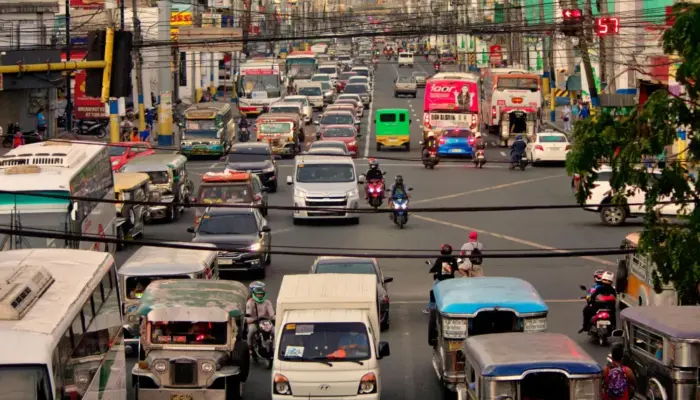
- Photo by Raynand Yray II from Pexels: https://www.pexels.com/photo/vehicles-on-road-6490680/
Leave a Reply