
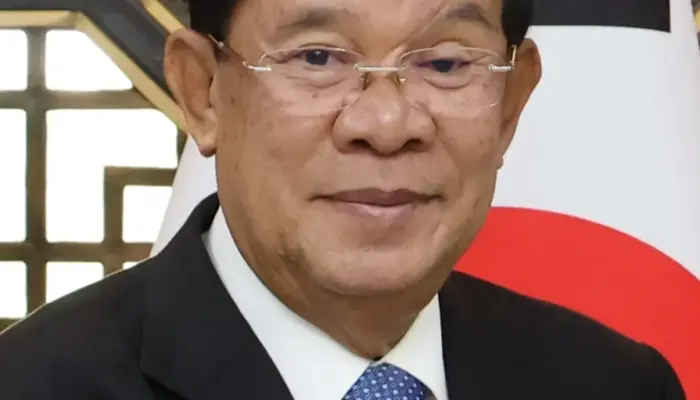
In August 2023, after nearly four decades as prime minister, Hun Sen stepped aside — and handed the job to his eldest son. It was the kind of move that would have drawn gasps in most democracies. In Cambodia, it barely raised an eyebrow. The transfer of power from father to son was the culmination of a political career unlike any other in Southeast Asia: a journey that began in the jungles of the Khmer Rouge, wound through a Vietnamese-backed puppet government, survived a coup, outlasted international pressure, and ended — or rather, didn’t quite end — with the construction of a family dynasty that now controls virtually every lever of power in the country.
Hun Sen is now 73 years old and serves as president of Cambodia’s Senate, a position that makes him acting head of state whenever King Norodom Sihamoni is abroad. His son Hun Manet sits as prime minister. His other sons hold senior military and political posts. His daughter controls major media and business interests. His in-laws, nieces, and nephews run companies across every profitable sector in the economy. The Cambodian People’s Party (CPP), which Hun Sen has led since 2015, holds 120 of 125 parliamentary seats.
To understand how one man achieved this level of control — and kept it for longer than any other leader in modern Asian history — you have to go back to where it started. And it started in a place that most Cambodians would rather forget.
The boy from Kampong Cham
Hun Sen was born Hun Bunal on 5 August 1952, in the village of Peam Kaoh Sna, Kampong Cham province — the third of six children. His father, Hun Neang, had been a monk before defrocking to join the French resistance and marry Hun Sen’s mother, Dee Yon. Hun Neang’s paternal grandparents were wealthy landowners of Chinese heritage, and the family had a relatively comfortable existence until a kidnapping incident forced them to sell off most of their land.
At 13, the young Hun Bunal left home to attend a monastic school in Phnom Penh. He changed his name along the way — his birth name, Nal, was a common nickname for overweight children, and he wanted to leave it behind. He would change his name several more times before settling on Hun Sen in 1972, two years after he abandoned his education entirely to pick up a gun.
Joining the Khmer Rouge
In 1970, General Lon Nol overthrew King Norodom Sihanouk in a military coup backed by the United States. Sihanouk, from exile in Beijing, called on Cambodians to join the Khmer Rouge insurgency against the new government. The 18-year-old Hun Sen answered that call. He later claimed he was also motivated by the American bombing of his hometown during Operation Menu, the secret carpet-bombing campaign that devastated parts of eastern Cambodia.
Hun Sen rose quickly through the ranks. He fought during the fall of Phnom Penh in April 1975, was seriously wounded, and lost vision in his left eye — an injury that would become part of his political mythology. By the time the Khmer Rouge controlled the country and began what would become one of the worst genocides of the 20th century, Hun Sen was a battalion commander in the Eastern Region, with authority over around 2,000 men.
His involvement in the Cambodian genocide — which killed an estimated 1.5 to 2 million people — remains one of the murkiest chapters in his biography. He denies complicity. Human Rights Watch has suggested he may have had a role in a massacre to suppress Cham Muslim unrest in 1975, though Hun Sen claims he had already stopped following orders from the central leadership by that point. What is clear is that by 1977, as Pol Pot’s internal purges accelerated and began targeting cadres in the Eastern Region, Hun Sen saw the writing on the wall. He and his battalion fled across the border to Vietnam.
Vietnam’s man in Phnom Penh
Vietnam was already preparing to invade Cambodia, and Hun Sen’s defection was useful. He became one of the leaders of the Kampuchean United Front for National Salvation, the Vietnamese-sponsored rebel army. After Vietnam’s forces toppled the Khmer Rouge in January 1979, the 26-year-old Hun Sen was installed as deputy prime minister and foreign minister in the new puppet government — making him, at the time, the youngest foreign minister in the world.
The early years were chaotic. The People’s Republic of Kampuchea was essentially a Vietnamese client state, unrecognised by most of the world and fighting ongoing insurgencies from the Khmer Rouge and other factions along the Thai border. Hun Sen spent this period consolidating his position within the ruling party and learning the mechanics of power — patronage, intelligence networks, and the strategic use of force.
In January 1985, the one-party National Assembly appointed the 32-year-old Hun Sen as prime minister after his predecessor, Chan Sy, died in office. It was an appointment encouraged by senior politburo cadres who saw the young leader as manageable. They miscalculated.
Surviving the peace
The 1991 Paris Peace Accords were supposed to bring multiparty democracy to Cambodia. A massive UN peacekeeping operation — the United Nations Transitional Authority in Cambodia (UNTAC) — arrived to supervise free elections. It was one of the most expensive and ambitious peacekeeping missions the UN had ever undertaken.
The 1993 elections delivered a result that would test Hun Sen’s commitment to democracy, and he failed the test immediately. The royalist party FUNCINPEC won a plurality, but Hun Sen refused to accept the result. With the army, police, and state apparatus firmly under his control, he and his deputy threatened to lead seven provinces into secession. CPP-backed forces committed acts of violence against both UN personnel and FUNCINPEC supporters.
The international community blinked. Rather than enforce the election result, UNTAC and FUNCINPEC agreed to a bizarre power-sharing arrangement: Prince Norodom Ranariddh would serve as “First Prime Minister” and Hun Sen as “Second Prime Minister.” On paper, Ranariddh had seniority. In practice, Hun Sen held the real levers — the security forces, the intelligence services, and the sprawling patronage network he had built during the Vietnamese years.
The 1997 coup
The coalition was always unstable, and by 1997 it collapsed. FUNCINPEC had been in discussions with remnants of the Khmer Rouge about absorbing their forces — a move that would have shifted the military balance of power away from Hun Sen.
Hun Sen’s response was blunt. In July 1997, he launched a coup, ousting Ranariddh and consolidating control. Amnesty International documented summary executions of FUNCINPEC ministers and a systematic campaign of arrests and harassment of political opponents. The UN’s Special Representative for Human Rights in Cambodia condemned the takeover.
Internationally, the coup brought sanctions and isolation — which is where China entered the picture. Facing cold shoulders from Washington and Brussels, Hun Sen turned to Beijing. China opposed Western-backed sanctions and stepped in with grants, aid, and investment. It was the beginning of what Cambodian officials would later call an “ironclad friendship” — one that has shaped Cambodia’s geopolitics ever since.
The playbook: How Hun Sen stayed in power
Between 1998 and 2023, Hun Sen led the CPP to five consecutive election victories. Each one followed a broadly similar pattern: suppress the opposition before the vote, control the media narrative, use the courts to eliminate rivals, win by a landslide, then point to the result as democratic legitimacy. As Foreign Policy observed, he dressed up one-man rule in the language of constitutionalism and the rule of law — concepts he frequently referenced and even more frequently disregarded in practice.
Eliminating the opposition
The most direct threat Hun Sen ever faced came in 2013, when the newly formed Cambodia National Rescue Party (CNRP) — a merger of existing opposition groups under Sam Rainsy and Kem Sokha — won 44% of the popular vote against the CPP’s 48%. It was the closest Hun Sen had come to losing. Tens of thousands of protesters poured into the streets of Phnom Penh. The government responded with riot police, live ammunition, and mass arrests. In January 2014, military police opened fire on demonstrators, killing at least four people and injuring more than 20.
The 2013 scare changed Hun Sen’s calculus. Rather than risk another close election, he moved to dismantle the opposition entirely. In 2017, the CPP-aligned Supreme Court dissolved the CNRP altogether, banning 118 of its members from politics. Opposition leader Kem Sokha was arrested on treason charges that human rights organisations called politically motivated. Sam Rainsy was forced into exile in France, charged with numerous offences in absentia and barred from returning.
The effect was immediate. In the 2018 election, with no credible opposition on the ballot, the CPP won all 125 seats in the National Assembly. The European Union and the United States refused to send observers, saying the conditions for a free and fair election did not exist. Before the 2023 election, the pattern repeated: the Candlelight Party, the CNRP’s unofficial successor, was barred from running on a technicality. The CPP won 120 of 125 seats.
Controlling the media
A free press in Cambodia has been systematically dismantled over the past decade. In 2017, the government forced the closure of The Cambodia Daily, one of the country’s most respected English-language newspapers, by hitting it with an unaffordable $6.3 million tax bill. The following year, The Phnom Penh Post was sold to a Malaysian businessman with reported ties to Hun Sen, and its editorial independence evaporated. Over 30 independent FM radio stations were shut down for broadcasting programmes from outlets like Radio Free Asia.
The final blow came in February 2023, when Hun Sen ordered the revocation of the operating licence of Voice of Democracy (VOD), one of Cambodia’s last remaining independent domestic news outlets. The pretext was a report suggesting that Hun Manet had signed an aid document on behalf of his father — a story that quoted a government spokesperson. VOD sent letters of regret, but Hun Sen rejected them for not using the word “apologise.” Human Rights Watch called it a “devastating blow to media freedom.”
The result, as the East Asia Forum noted, is that the government now effectively controls all national TV and radio stations broadcasting in Khmer, as well as the country’s major Khmer-language newspapers. Government-aligned outlets like Fresh News have replaced independent reporting. Cambodia ranked 142nd out of 180 countries in the Reporters Without Borders press freedom index, and Freedom House rated the country “Not Free” in its 2025 report.
Using the courts
Hun Sen’s judiciary has served as one of his most effective tools. The courts that dissolved the CNRP, convicted Kem Sokha of treason, and barred the Candlelight Party from elections are widely understood to be extensions of CPP authority rather than independent institutions. Loosely worded laws on treason, incitement, and lèse-majesté have been used to prosecute government critics, journalists, and opposition supporters. As Foreign Policy’s Charles Dunst wrote, Hun Sen speaks in legal terms and references constitutional concepts — but only to camouflage authoritarian governance in the language of democratic legitimacy.
The patronage machine
Force and media control are only part of the story. Hun Sen’s system runs on money — specifically, on a vast patronage network that reaches from Phnom Penh boardrooms to provincial villages. As a veteran environmental activist in Cambodia described the system to Foreign Policy: it functions like a textbook organised crime cartel, with Hun Sen in the role of godfather. “He has to feed the dogs. If he’s not feeding them every month, they won’t be loyal anymore.”
A 2016 investigation by Global Witness laid bare the scale of the Hun family’s commercial interests. Using data from Cambodia’s company registry (to which online access was subsequently restricted), the report found that the prime minister’s immediate family held interests in at least 114 domestic companies with a combined registered value exceeding $200 million. The true figure, the report stressed, is almost certainly far higher — the family is adept at hiding holdings through nominees and shell companies. Estimates of the clan’s total wealth range from $500 million to as high as $4 billion.
The family’s footprint spans virtually every profitable sector: energy, telecoms, mining, real estate, construction, tourism, aviation, media, banking, and consumer goods. Hun Sen’s eldest daughter, Hun Mana, has registered interests in at least 22 companies, including major broadcasting firms. The family holds exclusive distribution rights for brands including Apple, Nokia, Honda, Visa, Unilever, and Nestlé in Cambodia. Hun Sen’s wife, Bun Rany, runs the Cambodian Red Cross, the country’s largest charity — which also doubles as a political tool, allowing the ruling party to claim credit for infrastructure projects funded by the organisation.
As Global Witness put it: among the cruellest ironies of Hun Sen’s model of dictatorship is that ordinary Cambodians can barely get through a day without lining the pockets of their oppressors. Meanwhile, around 40% of the population still lives below or near the poverty line.
The China card
China has been central to Hun Sen’s survival — and the relationship is a study in mutual convenience. After the 1997 coup left Hun Sen internationally isolated, Beijing filled the gap that Western donors left behind. China cancelled much of Cambodia’s debt, provided billions in loans and investment, and asked few questions about human rights or democracy in return.
The partnership deepened steadily. When the EU moved to revoke Cambodia’s preferential trade access under its “Everything But Arms” scheme — citing democratic backsliding and human rights abuses — Hun Sen shrugged it off, praising Beijing’s no-strings-attached support. Accumulated Chinese investment in Cambodia between 2005 and 2024 reached approximately $13.4 billion, making Cambodia the third-largest recipient of Chinese investment in Southeast Asia.
In return, Cambodia has served as a reliable proxy for Chinese interests within ASEAN — most notably on South China Sea disputes, where Phnom Penh has consistently blocked regional consensus on the issue. Cambodia was the first ASEAN country to sign a “Comprehensive Strategic Partnership” with China, and Hun Sen’s 2020 visit to Beijing at the height of the COVID-19 pandemic — the first by any foreign leader — was widely seen as a gesture of political solidarity.
The most controversial element is the Ream Naval Base in Sihanoukville, where China has financed the construction of a new pier and expanded facilities capable of hosting larger warships. In 2021, a US-funded facility at the base was demolished — a move widely interpreted as a signal of Cambodia’s overt alignment with Beijing. Cambodia officially denies granting China exclusive access to the base, but the evidence suggests otherwise.
The dynastic handover
By 2021, Hun Sen had publicly announced that he would support his eldest son, Hun Manet, as his successor. Manet — a West Point graduate with a master’s from New York University and a PhD from Bristol University — was already chief of Cambodia’s army. Despite his Western education, observers expected no meaningful change in direction. “I don’t think anyone expects Hun Sen to sort of disappear once Hun Manet is prime minister,” remarked Astrid Norén-Nilsson, a Cambodia scholar at Sweden’s Lund University.
After the CPP’s landslide victory in the July 2023 election — held without any significant opposition — Hun Manet was confirmed as prime minister in August. Hun Sen stepped down from the role he had held for 38 years. But “stepped down” is doing a lot of work in that sentence. He retained the presidency of the CPP, and in April 2024, he was unanimously elected president of the Senate — a position that makes him acting head of state whenever the king is abroad, which happens frequently given Sihamoni’s health.
The family’s grip extends well beyond the two men at the top. Hun Sen’s youngest son, Hun Many, serves as deputy prime minister. His other son, Hun Manith, holds a senior military intelligence position. The wives, in-laws, and children of Hun Sen’s siblings and allies occupy key roles across the government, military, police, and business sectors. As political analyst Ou Virak told AFP: “In Cambodia, symbolism is everywhere and everything.”
Where things stand now
As of 2026, Hun Sen remains the most powerful figure in Cambodian politics, even without the prime minister’s title. His party controls parliament. His son runs the government. His family dominates the economy. The opposition is either dissolved, exiled, or in prison — Sam Rainsy remains in France, while Kem Sokha is under house arrest appealing a 27-year treason sentence.
There are some signs that Hun Manet is attempting a modest recalibration of Cambodia’s foreign policy. He has cultivated ties with Japan, South Korea, Australia, and even made overtures to the United States, allowing a US warship to dock in Sihanoukville and inviting Japan’s Self-Defence Forces to visit Ream Naval Base. Cambodia attracted $8.1 billion in foreign direct investment between September 2023 and September 2024, with China leading but no longer monopolising. But analysts caution that this diversification represents a refinement, not a rupture — China remains the pre-eminent partner, and Hun Sen’s 2021 refrain still holds: “If I don’t rely on China, who will I rely on?”
Domestically, cracks are appearing beneath the surface. Cambodia’s economy suffers from the world’s highest levels of consumer debt relative to income. The real estate sector is wobbling. Chinese tourists and investors have not returned in significant numbers since the pandemic. Nearly two-thirds of Cambodians are under 30, and younger voters — who don’t feel they owe Hun Sen for delivering the country from the Khmer Rouge era — are less inclined to support the CPP. Freedom House gave Cambodia a score of just 23 out of 100 in its 2025 freedom assessment.
Whether those pressures eventually produce change, or whether the Hun dynasty has built a system resilient enough to absorb them, is the defining question of Cambodian politics. What’s clear is that Hun Sen’s half-century journey — from barefoot teenage soldier to the patriarch of a political-economic empire — represents one of the most remarkable and ruthless exercises in power consolidation that modern Southeast Asia has seen.
Sources
- Wikipedia – Hun Sen
- Britannica – Hun Sen biography
- Human Rights Watch – 30 Years of Hun Sen: Violence, Repression, and Corruption in Cambodia (2015)
- The Business Standard – Hun Sen’s Playbook for Power (July 2023)
- Global Witness – Hostile Takeover: The Corporate Empire of Cambodia’s Ruling Family (2016)
- Al Jazeera – New Report Exposes Cambodian PM’s Vast Family Wealth (July 2016)
- Foreign Policy – Lifestyles of the Rich and Shameless (July 2016)
- Foreign Policy – In Cambodia, Hun Sen Uses the ‘Rule of Law’ to Undermine Democracy (December 2019)
- Lowy Institute – Hun Sen’s All-Encompassing Rule of Cambodia (December 2021)
- Lowy Institute – Cambodia: Playing the Long Game Against Hun Sen
- Human Rights Watch – Cambodia: Hun Sen Extinguishes Media Freedom (February 2023)
- Al Jazeera – Cambodia’s Hun Sen Shuts Down Independent Media Outlet (February 2023)
- East Asia Forum – Hun Sen’s Fight to Control the Cambodian Infosphere (May 2023)
- PBS News – Cambodian PM Hun Sen’s Ruling Party Wins Election by Landslide (July 2023)
- NPR – Cambodia’s Hun Sen Is Set to Win an Election Again After Opposition Suppressed (July 2023)
- France 24 – Cambodia’s Ex-Leader Hun Sen Unanimously Voted In as Senate President (April 2024)
- East Asia Forum – Cambodia’s Strategic Positioning Between the US and China (January 2024)
- Frontiers in Political Science – Deciphering Recent Events in the Ream: Cambodia’s Bandwagoning with China (2025)
- Lowy Institute – Cambodia Recalibrates Its China Policy, Rather Than Realigns (April 2025)
- ResearchGate – Hun Sen’s Consolidation of Personal Rule and the Closure of Political Space in Cambodia (2018)
- Wikipedia – Cambodia–China Relations
- The Diplomat – How Rich Are Cambodia’s Hun Sen and His Family? (July 2016)
- The Diplomat – Shifting Tides in Phnom Penh (March 2025)
- Featured Image: Korean Culture and Information Service (KOCIS), CC BY-SA 2.0, via Wikimedia Commons
Leave a Reply