
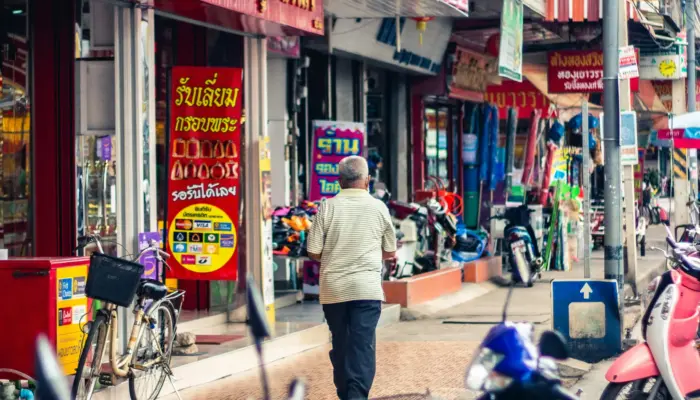
In a previous article on this site, we noted that Thailand’s richest 10% of the population earn just over half of all national income — roughly five times the share going to the entire bottom half of the country. That statistic is striking on its own. But income inequality, as measured by earnings and wages, is only part of the picture. Wealth — the accumulated stock of assets, land, corporate equity, and capital — tells an even starker story. And in Thailand, that story has a small cast of characters.
Thailand is not merely an unequal country. According to an accumulating body of academic literature, it is an oligarchic one — a society where extreme concentration of wealth translates, systematically, into political power, market control, and the suppression of competition. This article asks who those families are, how much they own, and whether Thailand’s inequality can be understood without grappling with the architecture of power that sustains it.
The Numbers First: How Concentrated Is Thai Wealth?
Before naming names, it is worth establishing the scale of the problem — because the data is genuinely exceptional by global standards.
Credit Suisse’s Global Wealth Reports, which track wealth distribution across more than 50 countries, have consistently ranked Thailand among the most unequal nations on earth, with the top 1% holding approximately 56–67% of total national wealth depending on the year and methodology used. The 2026 World Inequality Report, produced by over 200 economists affiliated with the World Inequality Lab, singled out Thailand as a country where inequality “remains high and has increased over the past decade.” Its findings for Thailand are among the most extreme in Southeast Asia: the wealthiest 10% hold roughly 65% of all wealth, with nearly half of that concentrated in the top 1% alone.
On income, the pattern is equally pronounced. The top 10% of earners capture 52% of total national income — 47 times the total income share of the bottom 50%, who receive only 11%. The World Inequality Lab notes that this income gap has widened since 2014, indicating not a static situation but a worsening one.
At the corporate level, research by Thailand’s own central bank research arm — the Puey Ungphakorn Institute for Economic Research — found that approximately 36% of all corporate equity in Thailand is held by just 500 people. Each of those 500 individuals collects an average of 3.1 billion baht (around US$90 million) in annual corporate profits. The average Thai household income is approximately US$10,000 a year.
These are not the statistics of a merely unequal market economy. They are the statistics of a society where the commanding heights of the economy have been captured by a remarkably small number of families — and where that capture has been stable across decades.
The Families: A Portrait of Thai Oligarchy
Thailand’s business elite is not a random collection of successful entrepreneurs. It is, in large part, a set of Thai-Chinese conglomerate dynasties whose origins date to the mid-twentieth century, and whose wealth has been compounded across generations through a combination of political access, regulatory capture, and market dominance in sectors that are structurally difficult for new entrants to penetrate.
The Yoovidhya Family (TCP Group / Red Bull) — ~US$44.5 billion
The wealthiest family in Thailand as of 2025, according to Forbes, is the Yoovidhya clan — heirs to the Red Bull fortune. The family’s 51% stake in the Red Bull brand, co-founded by the late Chaleo Yoovidhya alongside Austrian entrepreneur Dietrich Mateschitz in the 1980s, has generated extraordinary returns as the energy drink became one of the most recognised consumer brands on earth. In 2024, Red Bull sold nearly 13 billion cans globally, generating revenues of approximately €11.2 billion (around US$12.9 billion). The family’s combined fortune surged to a record US$44.5 billion in 2025 — an increase of US$8.5 billion in a single year.
The Yoovidhya name is also associated with one of Thailand’s most widely discussed cases of elite impunity. Vorayuth Yoovidhya, a grandson of the founder, struck and killed a police officer with his Ferrari in Bangkok in 2012 and subsequently fled the country in 2017. Despite multiple criminal charges, all charges were eventually dropped by Thai prosecutors in 2020, prompting widespread public outrage and international attention. The episode illustrated, to many observers, not merely the scale of the family’s wealth but its capacity to operate beyond the reach of the law that applies to ordinary Thais.
The Chearavanont Family (CP Group) — ~US$35.7 billion
The Chearavanont brothers of Charoen Pokphand Group — CP Group — represent perhaps the most systemically embedded family business in Thailand. Founded in 1921 by Chia Ek Chor and his brother, who arrived from Shantou, China to sell seeds to Thai farmers, CP Group has grown into one of Asia’s largest conglomerates, with operations spanning agribusiness, food production, retail, and telecommunications.
The scope of CP Group’s domestic presence is staggering. The conglomerate effectively controls Thailand’s food supply chain from farm to shelf: it is among the world’s largest producers of animal feed and livestock, and domestically it owns the 7-Eleven convenience store network, Lotus’s supermarkets, and Makro wholesale stores. Its telecommunications arm, True Digital (created through the 2023 merger of True Corporation and DTAC), is one of Thailand’s largest mobile operators. The family’s combined net worth reached US$35.7 billion in 2025, up 23% from the prior year, as the group doubled down on digital infrastructure, committing US$1 billion alongside BlackRock to build data centres in the region.
In land, CP Group ranks as the second-largest private landholder in Thailand, with more than 200,000 rai (roughly 320,000 hectares) under ownership or control, including a landmark 10,000-rai plot in Ayutthaya. It has also been the beneficiary of significant state contracts, including a US$7.5 billion high-speed railway concession connecting three Bangkok-area airports — despite having no prior experience in major rail infrastructure.
The Sirivadhanabhakdi Family (ThaiBev / TCC Group) — ~US$10.5 billion
Charoen Sirivadhanabhakdi, son of a Bangkok street vendor, is a self-made billionaire in the most literal sense — and also the single largest private landowner in Thailand. A survey by the NGO Local Action Links found that the Sirivadhanabhakdi family controls approximately 630,000 rai of land across Thailand — a figure that dwarfs every other private landholding in the country.
Charoen’s business empire is anchored by Thai Beverage (ThaiBev), Thailand’s dominant beer and spirits producer, known for Chang beer and the Ruang Khao rice whisky brands that together hold commanding positions in their respective markets. His retail empire includes the Big C Supercenter hypermarket chain. Through his Singapore-listed holding company Fraser & Neave, he controls hotels, beverages, and real estate assets across Southeast Asia. His property vehicle, Asset World Corporation, manages luxury hotels and commercial real estate across Thailand. Altogether, the Sirivadhanabhakdi family’s footprint touches beverages, land, retail, hospitality, and a substantial portion of commercial Bangkok.
The Chirathivat Family (Central Group) — ~US$15.7 billion
The Chirathivat family controls Central Group, Thailand’s dominant retail and hospitality conglomerate. From its origins as a single department store in Bangkok in 1947, Central has expanded into a multi-format empire spanning malls, hotels, food and beverage chains, and luxury retail across Thailand, Southeast Asia, and Europe. Domestically, it operates Central Department Store, Robinson, and a string of premium shopping centres. Internationally, the group has moved aggressively: in April 2024, Central Group acquired the iconic KaDeWe department store building in Berlin for over US$1 billion, having previously taken a controlling stake in Selfridges in the United Kingdom. The family’s combined net worth stood at approximately US$15.7 billion in 2025, ranking them among Asia’s 20 wealthiest families according to Bloomberg.
Sarath Ratanavadi (Gulf Energy Development) — ~US$12 billion
Sarath Ratanavadi represents a newer archetype in Thai elite wealth: a tycoon whose fortune has been built primarily through state-adjacent energy and infrastructure contracts rather than the traditional agribusiness or retail model. Gulf Energy Development, which he leads as CEO, has become Thailand’s largest private power producer, with a concession model that depends heavily on government power purchase agreements. In 2025, Gulf’s joint venture with Singtel and AIS to build data centres began operations, and the company acquired a significant stake in Kasikornbank, becoming the fourth-largest shareholder of Thailand’s third-largest bank by assets. Sarath’s estimated fortune of US$12 billion places him firmly among Thailand’s top five wealthiest individuals — and his trajectory illustrates how close proximity to state procurement has become a reliable path to dynastic wealth in its own right.
The Structure of Oligarchy: How Wealth Becomes Power
Listing these families and their net worths is only the beginning of the analysis. The more consequential question is: how does this concentration of wealth translate into the kind of structural inequality that leaves the bottom 50% of Thais with 11% of national income — a share that has barely moved since 1988?
The political science literature on Thailand has increasingly used the term “oligarchy” with justification. As academic T.F. Rhoden argued in a 2015 paper in the Journal of Current Southeast Asian Affairs, the defining feature of an oligarch is not simply being rich, but using material wealth “as political power” — specifically to protect and extend that wealth against redistribution or competitive challenge. In Thailand, this dynamic is visible across four interlocking dimensions.
Market Dominance as a Barrier to Entry
CP Group’s control of the food supply chain — from animal feed to the 7-Eleven network — means that a Thai farmer or food entrepreneur operates within an ecosystem largely defined by one family’s commercial interests. ThaiBev’s dominance of the beer and spirits market is protected by high government tariffs on imported alcohol and production regulations that have effectively prevented the craft beer sector from gaining meaningful scale. Critics, including opposition politician Thanathorn Juangroongruangkit, have described too many Thai business sectors as characterised by “oligopolistic and monopolistic structures” that create “rent-seeking opportunities” for established families at the expense of broader competition. The structural effect is a market that rewards incumbency and penalises new entrants — in sector after sector, across decade after decade.
Political Access and State Contracts
The relationship between Thailand’s major business families and the state is more intimate than mere lobbying. When the military-aligned Palang Pracharat Party organised a fundraising dinner during the 2019 election cycle, the major conglomerates — CP Group, ThaiBev, King Power, Central Group — were at the top tables. The dinner raised 622 million baht for the party’s war chest. In the years that followed, CP Group received a US$7.5 billion high-speed rail concession; Gulf Energy’s telecom licences were extended by executive order weeks after the election; and ThaiBev continued to benefit from a regulatory environment that limits alcohol market competition. These are not coincidences — they are the mechanics of oligarchic political economy, in which the capacity to donate is repaid through the capacity to regulate.
Land and the Exclusion of the Rural Poor
Land ownership in Thailand is among the most concentrated in the region. A 2016 Thammasat University study found that 80% of the country’s land is owned by the wealthiest 5% of the population. With the Sirivadhanabhakdi family holding 630,000 rai and CP Group holding 200,000 rai, the structural exclusion of smallholder farmers and the rural poor from asset accumulation is not an accident of development — it is a feature of the ownership architecture. In the Northeast region of Isan, where more than a quarter of Thailand’s population lives and where the country’s rural poverty is most concentrated, GDP per capita is less than one-sixth that of Bangkok. That spatial inequality is not a natural outcome of geography. It is the result of a decades-long development model that has concentrated investment, infrastructure, and land ownership in the hands of Bangkok-based elites.
Low Taxation and Dynastic Compounding
Thailand’s tax system has historically done very little to challenge wealth concentration. As late as 2010, only 2.3 million of 9 million registered taxpayers actually paid any income tax — out of a total population of approximately 64 million. Effective capital gains tax, inheritance tax, and wealth taxes have been weak or absent for most of the country’s modern economic history. Without progressive redistribution mechanisms, the compounding of dynastic wealth across generations proceeds largely unimpeded. The families profiled in this article did not merely build wealth — they inherited, diversified, and multiplied it across two and three generations, in a tax environment that placed few obstacles in their path and offered no meaningful floor beneath those at the bottom.
Why This Matters Beyond Thailand
Thailand’s experience is not unique in Southeast Asia — versions of the same dynastic concentration can be found in the Philippines (the Sy, Ayala, and Villar families), in Malaysia (the historical dominance of state-linked capital and Bumiputera conglomerates), and in Indonesia (where the Hartono brothers and Prajogo Pangestu hold vast cross-sector portfolios). But Thailand is an unusually clear case study because the data is relatively well-documented, the academic literature is well-developed, and the concentration is extreme even by regional standards.
The Thailand case also illustrates a structural argument about why growth alone does not solve inequality. Between the early 1990s and 2019, Thailand’s economy grew substantially — and poverty fell significantly. But the income share of the bottom 50% barely shifted, while the wealth of the top families grew faster than the overall economy. This is what economists refer to as the difference between growth and distribution: an economy can expand while the underlying ownership structure ensures that most of the gains accumulate at the top.
The 2026 World Inequality Report puts it plainly: in countries like Thailand, “the ultra-wealthy have not been slow to transform their economic power into political power” in order to resist redistributive policies. Oligarchy is, in this sense, self-reinforcing. The families that benefit most from the existing system are also the families best positioned to ensure that the system does not fundamentally change.
What Would Change Look Like?
Thailand is not without reformist voices. Opposition political movements, civil society researchers, and progressive economists have put forward an agenda that would begin to shift the balance. Its elements are well-known even if politically difficult: a meaningful land value tax that captures the returns to large landholding; a progressive inheritance tax to interrupt the intergenerational compounding of dynastic wealth; stronger anti-monopoly enforcement to open markets currently dominated by a small number of family conglomerates; greater transparency requirements for large corporate groups and their political donations; and sustained investment in the rural economies — particularly Isan — that have been systematically marginalised by a development model centred on Bangkok.
None of these reforms is technically complicated. Most have been successfully implemented in countries that have managed to reduce extreme wealth concentration without sacrificing economic dynamism. The obstacle in Thailand is not technical — it is political. A system in which a small number of families exercise disproportionate influence over the state has, by definition, limited incentives to reform itself.
Thailand’s poverty reduction over the past half-century is a genuine achievement that should not be dismissed. But the country now faces a harder question than it did in 1975: not whether to grow, but how to ensure that the next phase of growth is shared by the 50 million Thais who have so far received the smallest share of what their country has produced. Answering that question honestly requires naming the structure that has prevented it — and that structure has a small number of very identifiable faces.
Key Data Summary
| Metric | Figure | Source |
|---|---|---|
| Top 1% share of total wealth | ~56–67% | Credit Suisse Global Wealth Report; World Inequality Lab 2026 |
| Top 10% share of total wealth | ~65% | World Inequality Lab 2026 |
| Top 10% share of national income | ~52% | World Inequality Lab 2026 |
| Bottom 50% share of national income | ~11% | World Inequality Lab 2026 |
| Corporate equity held by top 500 individuals | ~36% | Puey Ungphakorn Institute for Economic Research |
| Land owned by richest 5% | ~80% of titled land | Thammasat University, 2016 |
| Largest private landowner (Sirivadhanabhakdi family) | 630,000 rai | Local Action Links survey |
| Combined wealth of Forbes Top 50 (2025) | US$170.5 billion | Forbes Thailand 2025 |
Thailand’s Wealthiest Families at a Glance (2025)
| Family / Individual | Core Business(es) | Est. Net Worth (2025) | Key Assets |
|---|---|---|---|
| Yoovidhya (TCP Group) | Red Bull energy drink | US$44.5 billion | 51% stake in Red Bull global brand |
| Chearavanont (CP Group) | Agribusiness, retail, telecoms | US$35.7 billion | 7-Eleven, Lotus’s, Makro, True Digital, 200,000+ rai of land |
| Chirathivat (Central Group) | Retail, malls, hospitality | ~US$15.7 billion | Central Department Store, Selfridges (UK), KaDeWe (Germany) |
| Ratanavadi (Gulf Energy) | Energy, infrastructure, banking | US$12 billion | Gulf Energy Development, stake in Kasikornbank |
| Sirivadhanabhakdi (TCC / ThaiBev) | Beverages, land, retail, hotels | US$10.5 billion | ThaiBev, Big C, Fraser & Neave, 630,000 rai of land |
Sources & Data
- World Inequality Lab — World Inequality Report 2026 — income and wealth share data for Thailand
https://wid.world - Forbes Thailand’s 50 Richest 2025 — individual and family net worth rankings
https://www.forbes.com/thailand - World Bank — Bridging the Gap: Inequality and Jobs in Thailand (2023)
https://www.worldbank.org/en/country/thailand/publication/bridging-the-gap-inequality-and-jobs-in-thailand - Credit Suisse Global Wealth Report 2018 / 2022 — wealth Gini and top 1% wealth share estimates
- Puey Ungphakorn Institute for Economic Research — Corporate Equity Ownership in Thailand
Bank of Thailand Research Institute - Prachatai English — Thailand’s Economic Inequality Worsens (2026)
https://prachataienglish.com/node/11697 - Asia Times — Thailand’s ‘Five Families’ Prop and Imperil Prayut (2019)
https://asiatimes.com/2019/12/thailands-five-families-prop-and-imperil-prayut/ - Rhoden, T.F. — “Oligarchy in Thailand?” Journal of Current Southeast Asian Affairs, 2015
https://journals.sagepub.com/doi/full/10.1177/186810341503400101 - Phongpaichit, P. and Baker, C. (eds.) — Unequal Thailand: Aspects of Income, Wealth and Power. NUS Press, 2016
- Hewison, K. — “Crazy Rich Thais: Thailand’s Capitalist Class, 1980–2019.” Journal of Contemporary Asia, 2021
https://www.tandfonline.com/doi/abs/10.1080/00472336.2019.1647942 - Bangkok Post — “Charoen Owns Most Land” (2014)
https://www.bangkokpost.com/thailand/politics/416020/charoen-owns-most-land - WID Issue Brief 2019-1 — Extreme Inequality, Democratisation and Class Struggles in Thailand
https://wid.world/document/extreme-inequality-democratisation-and-class-struggles-in-thailand-wid-world-issue-brief-2019-1/ - United Nations Thailand — Building a More Equal and Sustainable Thailand After COVID-19
https://thailand.un.org/en/90303-thailand-economic-focus-building-more-equal-and-sustainable-thailand-after-covid-19-un - Reuters Institute for the Study of Journalism — Thailand Media Report 2024
https://reutersinstitute.politics.ox.ac.uk/digital-news-report/2024/thailand - Photo by Chun-ja Bustamante: https://www.pexels.com/photo/local-street-with-parked-motorcycles-4588504/
Leave a Reply